Monday, 7 April 2014

Great Grey Shrike


Back in November I posted a distant shot of a Great Grey Shrike. It was one of two that have spent the winter in the Forest of Dean. I've seen both on numerous occasions since then, and a couple of weeks ago I finally got some better photos of one of them. It's the same bird that I photographed back in Novemeber, at Crabtree Hill. I also noticed this small snack that it had skewered on to a hawthorn bush to eat later. No doubt both birds will be leaving for their breeding grounds in Scandinavia shortly.


Sunday, 6 April 2014

Great Skua


While travelling between the islands of Mull and Coll in search of Basking Sharks and cetaceans, my attention was diverted by an incredibly close Great Skua. It's tricky to take in-flight shots from a boat as it lurches over the waves, but if you take enough shots, sooner or later some of them will turn out ok!

Badger


This photo is almost 5 years old, and is probably the first occasion I'd managed to get close enough for sharp and detailed shots. Over the next couple of years I made repeated visits to this sett along with one or two others. In more recent years I've not spent enough time with Badgers to get quite this close, but I still always enjoy seeing them. The Badger in this photo would be approximately 6 months old at the time the shot was taken - one of three siblings to make an appearance that evening.

A New Look

With spring arriving, bringing with it a host of migrant species, and others coming out of hibernation, coupled with the fact that I've neglected this site for a number of weeks, I decided it was time for a re-design and a slight change of direction. Hopefully visitors will find the new design to be cleaner and more attractive. There's still the odd tweak or two to be made, but I think it's sufficiently complete for me to start posting to it again. If anyone spots any bugs, etc, please let me know!

Black Grouse


This Black Grouse was photographed at the beginning of a trip to the Cairngorms three weeks ago. It was a pre-dawn start, with the hope of watching some lekking behaviour. The lekking didn't happen, but there was great views of both Black and Red Grouse, and it was a good way to start off the trip. I'm already looking forward to the next trip to the Cairngorms, which is taking place very shortly.

Tuesday, 4 February 2014

Red-flanked Bluetail

More photos below text... The Red-flanked Bluetail is an exceptionally rare bird to see in Britain. With only 34 total records at the BTO, this small bird is seen on average once a year, but even more unusual is the fact that this one was seen in February - the first time this bird has ever been seen wintering in Britain.
If you don't catch a glimpse of the tail, or fail to notice that the red doesn't extend across the breast, then it would be easy to dismiss this bird as a Robin, but when viewed from the front, or particularly the back, it's obvious this is a special bird. Normally wintering in south-east Asia, and breeding in Russia, it's a long way from home, but seemed to be active and doing well in the surroundings of a valley in South Gloucestershire, where it was discovered yesterday. I wonder how long it has been there unnoticed...


Tuesday, 14 January 2014

Northern Fulmar


Despite their looks, Fulmars are more closely related to the likes of petrels, shearwaters and albatrosses than they are to gulls. They are easy to recognise in flight due to their stiff-winged flapping. Found only on St Kilda until the 1900s, the islanders harvested them for a wide range of uses; fulmar oil (vomited over those who disturb the nest) was prized for its supposed medicinal properties.
This particular bird was photographed on the cliffs of Pembrokeshire, at Martin's Haven.

White Ermine


The White Ermine is widely distributed around Britain and flies from May to September. It is distasteful to birds, which is an attribute that is possibly also of benefit to the Buff Ermine which shares a similar appearance. This particular moth was found near the Ynys Hir reserve whilst there for Springwatch in 2013.

Monday, 13 January 2014

Wasp Spider


Found on heathland in Dorset in summer 2013, the Wasp Spider. It's a very large, colourful spider that is a recent arrival in the UK from the continent and has slowly spread over the south of England. They build large orb webs in grassland and heathland, and attach their silk egg-sacs to the grasses. The web has a wide, white zig-zag strip running down the middle, known as a 'stabilimentum', the function of which is unclear. Mating is a dangerous game for males; they wait at the edge
of the web until the female has moulted into a mature form, then take advantage of her jaws being soft and rush in to mate. However, many males still get eaten during this time.

Slavonian Grebe

The newest addition to the species list is the Slavonian Grebe, which was viewed from Brixham Harbour in Devon. The harbour has witnessed some unusual birds recently, perhaps offering some shelter in the bad weather we've been experiencing. Also seen around the harbour that day were Purple Sandpiper, Great Northern Diver and White-billed Diver (the latter unfortunately not seen by me). In the breeding season
they are mainly found north and south of the Great Glen and in Strathspey and can be watched in the breeding season at the RSPB Loch Ruthven nature reserve. In winter they can be found around UK coasts with the Moray Firth, the Firth of Forth, the Clyde Estuary and Islay in Scotland and Pagham Harbour, Sussex being important sites.

Cirl Bunting

The Cirl Bunting was once common throughout south England, but due to changes in farming practice, its breeding grounds are now restricted to south Devon, where this photo was taken. This RSPB page detailing their Cirl Bunting Project gives more details about the reasons for their decline and what is being done about it. The Cirl Bunting
is like a small Yellowhammer, 15-16.5 cm in length (wing-span 22-22.5 cm) with a thick seed-eater's bill. The male has a bright yellow head, with a black crown, eyestripe and throat, and a greenish breast band across its otherwise yellow underparts, and a heavily streaked brown back. The female is much more like the Yellowhammer, but has a streaked grey-brown rump and chestnut shoulders.

Wednesday, 1 January 2014

Species List review

There were some really memorable additions to my photographic species list in 2013. Highlights included watching Basking Sharks feeding off the isle of Coll, Pine martens in the Scottish Highlands, watching a Hummingbird hawk-moth feeding in Lancashire in early November (!), and finally photographing a Water Vole in Gloucestershire. Avian highlights have included watching White-tailed Eagles, Golden Eagles and Hen Harrier in the Hebrides, watching territorial cuckoos chasing each other around the Dorset heaths, and searching for Great Grey Shrike and Two-barred Crossbills closer to home.

The 'one that got away' was definitely the Scottish Wildcat. Having spent a few nights out in the middle of nowhere on the west coast of Scotland I was rewarded with a sighting which will stay with me forever, but which resulted in no photograph.  Notable 'did not shows' for me of the year included the rare Tree Sparrow, Common Dolphins, and Pearl-bordered Fritillary among many others.

Finding new mammals is becoming increasingly difficult, but there are obvious opportunities amongst bats, rodents and cetaceans, all of which are under-represented, as well as some of the mustelids. Birds are also becoming harder to find, but there are still some obvious omissions. The reptile list is pretty much complete, featuring all native species and all but one introduced species. Sub-aquatic species are an obvious challenge, not least due to my lack of suitable equipment and general aversion to swimming. And I must finally get a moth trap going this year!

I don't make things any easier by insisting on a photographic record rather than just a sighting, but it's fun. The list itself is undoubtedly a bit 'trainspottery', but behind the list there have been countless hours spent enjoying everything that British nature has to offer - the list is merely an easy way for me to remember the characters I've met and observed along the way.

Happy new year!

Monday, 30 December 2013

Parrot Crossbill


A recent trip to Norfolk with a friend for a couple of days produced a flock of 8 Parrot Crossbills. On arriving at the site where the birds had been reported, it was clear we were probably in the right place. The habitat was typical of that of crossbills - we were surrounded by mature conifers. Scanning the tree-tops produced nothing and there was nothing to be heard either.
We noticed a small flock of birds land on a solitary bare tree trunk in the middle of an area of clearfell - the sort of place you might expect to instead see a shrike rather than a crossbill. After a while they flew in to the conifers, and it became apparent why they initially favoured the tree trunk. It was a freezing cold day, and blowing a gale, and it was only forecast to worsen as the day progressed. Up in the conifers the birds were being buffeted all over the place, with branches constantly blowing at them, and it didn't take long for them to return to the studier perches provided by the tree trunk. Apart from being a stockier bird, with a more pronounced bill, it is very similar in appearance to the Common Crossbill and Scottish Crossbill.

Saturday, 14 December 2013

Desert Wheatear

A Desert Wheatear was reported a couple of days ago, around the Severn Beach area of South Gloucestershire. It's such a rare visitor that there had only ever been one previous record in the county, so I paid a visit to try to see it for myself. It was a cold and drizzly day, and this little bird was well outside of it's range and no doubt feeling the effects. It was
seen by others to be feeding, and I saw it having a drink, and by all accounts it's doing ok this morning. I'm sure it will attract a lot of attention for the rest of its stay here, but hopefully it will find its way soon. Both western and eastern forms of the Desert Wheatear are rare vagrants to western Europe. The western Desert Wheatear breeds in the Sahara and the northern Arabian peninsula. The eastern race is found in the semi-deserts of central Asia and in winter in Pakistan and northeast Africa.

Tuesday, 3 December 2013

Two-barred Crossbill

The Two-barred Crossbill is a scarce visitor to Britain, but in recent weeks the Forest of Dean has played host to a flock. Two-barred Crossbill have a strong preference for Larch, and it is in Larch that I've observed them on two occasions, both times in the company of Common Crossbills. Whilst their colours are comparable with
the Common variety (red/pink male, green/yellow female), their most obvious distinguishing feature is the white wing bars.

Tuesday, 26 November 2013

Great Grey Shrike

This Great Grey Shrike took a couple of attempts to find, and even then the best I could manage was this very distant shot. The Shrike sits atop trees scanning for prey such as small vertebrates, small birds and large invertebrates. Once captured it will impale them on a spike to consume or
save for later. Small numbers of Great Grey Shrike visit the UK to winter here each year.

Thursday, 7 November 2013

Hummingbird Hawk-Moth

I've not long been home from working at RSPB Leighton Moss for two weeks for the filming of BBC Autumnwatch. I didn't take my camera gear, nor was there any time for photography anyway, but I did keep a small camera in my pocket. Just as well, as this Hummingbird Hawk-Moth appeared right outside the production office. Its long proboscis and its hovering behaviour, accompanied by an audible humming noise, make it look remarkably like a hummingbird while
feeding on flowers. Showing late in the year, and unusually far north, this was a treat to see, and something I've been wanting to get on the list for some time.

Monday, 14 October 2013

Glossy Ibis

I photographed this Glossy Ibis in Somerset at the weekend. I was restricted to distant shots, but nevertheless had great views of this bird. Whilst I don't know the origin of this particular Glossy Ibis, there's a good possibility it has arrived from Spain, as a number of the population there seem to winter in the UK. Glossy Ibises are threatened by wetland habitat degradation and loss through drainage, increased salinity,
groundwater extraction and invasion by exotic plants.

Wednesday, 25 September 2013

Bar-headed Goose

A trip down to Dorset last weekend resulted in another new addition to the species list - the Bar-headed Goose. There were only two, found amongst a group of Canada Geese at Lodmoor. Bar-headed geese can fly higher than Mount Everest making them the world's highest flying birds. These particular birds, whilst living in the wild, are presumed to be escaped from captivity.

Sunday, 8 September 2013

Black Redstart

The 351st addition to the species list... the Black Redstart. It had been sighted a number of times over the week, all the while remaining on a disused farm, so I thought it might be worth a visit. It didn't take too long to find, along with a number of
Goldfinch and Linnets. With fewer than 100 breeding pairs in the UK, the black redstart is on the amber list of Birds of Conservation Concern.

Friday, 30 August 2013

Pine marten

The Pine marten was another key species I intended to photograph on my recent trip to Scotland, and they didn't disappoint. This is just one of a large series of shots that had them clambering over rocks, climbing trees, and scrambling on top of each other. Part of the mustelid family of mammals, which includes Badger, Weasel, Otter and Stoat, Pine martens are
cat-sized, and live in native woodlands but can also live in conifer plantations and on rocky hillsides.

Wednesday, 21 August 2013

Goshawk

Blog updates have slowed down a little lately - been really busy with work, then away in Scotland for a bit. This shot is from closer to home though. In all the time I've lived in the Forest of Dean,
I'd never had a view of a Goshawk quite so good as this. Admittedly it was very brief, but long enough to get a couple of shots off.

Saturday, 17 August 2013

Basking Shark

It's been a while since my last update to this blog, not least because I've been away in Scotland and the Hebrides for the last couple of weeks, and prior to that I was busy with long days at work. One species I was particularly keen to see whilst in Scotland was the Basking Shark - the second largest fish after the Whale Shark.
Things didn't sound that promising when we arrived in Scotland. Basking Sharks were late arriving this year and sightings were only just beginning to happen. We headed out towards the island of Coll and quickly the waters calmed and the weather improved. Common and Grey seals were hauled out on the rocks in large numbers, unperturbed by our presence.

Suddenly a fin was spotted breaching the water, and the boat engine killed. Then another fin, and another. Before long we were in the midst of perhaps 10 Basking Sharks, sedately cruising the waters, mouths agape, filtering plankton. The average Basking Shark is about 8 metres long, and their colossal mouths up to a metre wide. It was a real treat to float around amongst them as they fed at the surface of the water, but I was kicking myself that I didn't take a GoPro attached to a pole for some underwater footage!

Sunday, 14 July 2013

Meadow Grasshopper (in pink!)

After a long and very hot day out with the camera yesterday, which was well rewarded with Goshawk photographs (watch this space!), today was a day for taking it easy. The dog still needed walking though, and I couldn't resist taking the camera with macro lens in case anything interesting turned up. I'm glad I did, as I
came across this very unusual and rare pink Meadow Grasshopper! The species itself is far from unusual, but the colouration, caused by a genetic abnormality makes it a little special.

Thursday, 4 July 2013

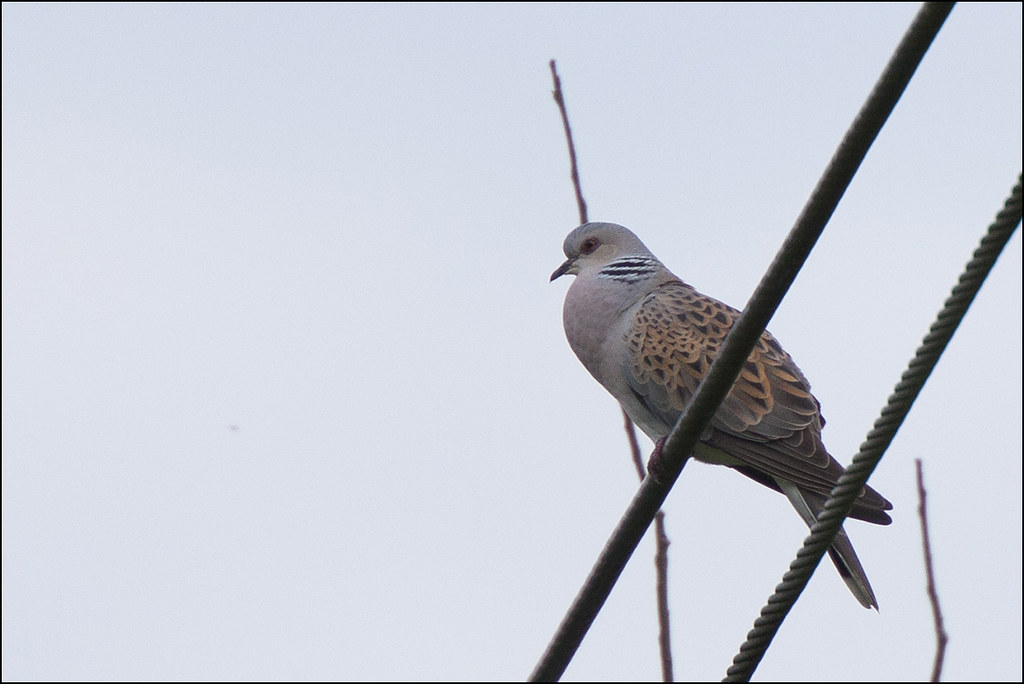
Turtle Dove

This Turtle Dove has been hanging about in the Forest of Dean for a while now. It took a few attempts to catch sight of it, but eventually it obliged by
perching on these power lines. It has undergone rapid decline in population and is now on the Red List of conservation concern.